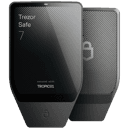
Trezor Safe 5 Review
Certified chip and fully open firmware at the lowest price
of 10
The Trezor Safe 5 scores 8.4/10 on desk research of Trezor's product page, chip explainer and GitHub repositories. A named EAL6+ chip, reproducible open firmware and a $109 price lift it to second. It signs only over USB-C, with no air-gapped route.
Overall
8.4/10 = (9 + 9 + 10 + 5 + 9) / 5
Price
$109 on trezor.io (1 Nov 2026), no sale marked
Secure element
OPTIGA Trust M (V3), CC EAL6+; wipes after 16 wrong PINs
Signing
USB-C only; 1.54-inch color touchscreen for confirmation
Open source
GPL-3.0 firmware, reproducible build guide, Safe 5 schematics
Assets
Thousands of coins and tokens; Bitcoin-only firmware available
Scores
Each criterion carries equal weight. The overall score is the average of these 5 scores — (9.0 + 9.0 + 10.0 + 5.0 + 9.0) ÷ 5 = 8.4.
Pros
- Price 9: $109 on trezor.io, the lowest in the category, with two backup cards
- Secure element 9: OPTIGA Trust M (V3) named, Common Criteria EAL6+
- Open source 10: GPL-3.0 firmware, reproducible builds and Safe 5 schematics
- Asset coverage 9: thousands of coins and tokens, or Bitcoin-only firmware
Cons
- Air-gap 5: signing needs a USB-C connection; no QR or documented microSD path
- Sending, swapping, setup and device management unavailable on iOS
- Secure element firmware itself is not published, as with every chip-based peer
The Trezor Safe 5 scores 8.4 out of 10, second in our hardware wallet ratings, rescored from current evidence on 1 November 2026. The basis is desk research of Trezor's product page and FAQ, its secure element explainer and the trezor-firmware and trezor-hardware repositories on GitHub. We did not test a device. Three marks moved, two up and one down. Trezor now names its chip, and its firmware and board files proved fully inspectable. The air-gap mark fell to the category's standard for connected-only signing.
How the Trezor Safe 5 scores in hardware wallets
Five criteria apply in this category. Each is marked 0 to 10 and carries equal weight, as described in our ratings methodology.
| Criterion | What the published record shows | Mark |
|---|---|---|
| Price & value | $109 on trezor.io on 1 November 2026, no sale marked; box includes a USB-C cable and two 20-word backup cards | 9 |
| Secure element | OPTIGA Trust M (V3), certified to Common Criteria EAL6+; erases its secret after 16 wrong PINs | 9 |
| Open source | Firmware under GPL-3.0 with documented reproducible builds; Safe 5 schematics published in trezor-hardware | 10 |
| Air-gap & verification | Signing over USB-C with Trezor Suite or third-party wallets; recipient and amount confirmed on a 1.54-inch touchscreen; no QR path, and no documented signing use for the listed microSD slot | 5 |
| Asset coverage | Universal firmware supports thousands of coins and tokens, including Bitcoin, Ethereum and Solana; Bitcoin-only firmware also offered | 9 |
The overall score is a plain average: (9 + 9 + 10 + 5 + 9) / 5 = 42 / 5 = 8.4.
Changes from the previous scoring:
- Secure element rose from 8 to 9. Trezor's explainer now names the chip as the OPTIGA Trust M (V3) and its certification as Common Criteria EAL6+, the same disclosure that gives Ledger 9.
- Open source rose from 8 to 10. The July review could not tell what was published. The trezor-firmware repository documents a deterministic, Docker-based reproducible build, and trezor-hardware holds Safe 5 schematics for board revisions F and G.
- Air-gap and verification fell from 7 to 5. The July mark appears to have credited the microSD slot. Neither the product page nor the Safe 5 FAQ documents signing through it, so the device signs only over a live connection. The category marks that 5, as it does the BitBox02 and the Ledger Nano Gen5.
Price and asset coverage are unchanged. The overall score moves from 8.2 to 8.4.
Strongest criteria
Open source (10)
Trezor's reproducible-build guide invites outsiders to rebuild a firmware release and check that it is identical to the official one. Nix, uv and Cargo pin the build environment, and a single Docker script runs it. The universal and Bitcoin-only images both come out of the same build. The trezor-hardware repository adds board schematics and views for the Safe 5. The firmware is licensed under GPL-3.0. Trezor says it picked a secure element that needs no non-disclosure agreement, so researchers can examine it. The chip's own internals are still not published.
Price & value (9)
At $109 the Safe 5 is the cheapest device in the category, and the product page showed no sale or crossed-out price. Two backup cards and a USB-C cable ship in the box. It stays at 9 rather than 10 because no backup accessory beyond paper cards is included.
Secure element (9) and asset coverage (9)
The OPTIGA Trust M does not hold the seed. It holds a secret that, together with the PIN, encrypts the keys stored on the main chip. It releases that secret only after the correct PIN and erases it after 16 wrong attempts. Asset coverage matches Ledger's: thousands of coins and tokens, given without an exact count.
Weakest criterion: connected signing
Air-gap & verification (5): a deficiency
Trezor Suite or a third-party app builds each transaction and sends it to the Safe 5 over USB-C. The device shows the recipient and amount for approval on its touchscreen, and that screen check is what protects against a compromised computer. There is no QR camera, no Bluetooth listed on the product page, and no documented air-gapped route. On iOS, the product page says sending, swapping, setup and device management are not available, so iPhone users need a desktop or Android setup.
What the score does not cover
- In-app trading. Buying, selling and swapping in Trezor Suite run through outside providers. Trezor says their fees vary and cannot be shown in advance. None of this is scored.
- The Safe 7. It adds a second secure element, TROPIC01, and is a separate device not scored here.
- Durability, touchscreen feel and support. We did not handle the device.
For what the secure element and PIN do and do not protect against, see our guide to hardware wallet security.
Trezor Safe 5 vs the closest rated peers
| Device | Price | Secure element | Open source | Air-gap | Assets | Overall |
|---|---|---|---|---|---|---|
| Keystone 3 Pro | 8 | 10 | 10 | 10 | 10 | 9.6 |
| Trezor Safe 5 | 9 | 9 | 10 | 5 | 9 | 8.4 |
| Ledger Nano Gen5 | 7 | 9 | 5 | 5 | 9 | 7.0 |
The Keystone 3 Pro leads by 1.2 points, almost entirely because it can sign over QR codes. Against the Ledger Nano Gen5, the Safe 5 has the same certified-chip standard, the same connected signing and the same asset mark. It finishes 1.4 points ahead on fully inspectable firmware and a $70 lower price.
Who it suits
On the scored evidence, the Safe 5 fits people who want a named, certified chip and firmware that anyone can rebuild, at the lowest price in the category. It also fits holders of many kinds of assets who are happy to sign over USB-C. It is not the device for anyone who needs air-gapped signing, or who wants to manage everything from an iPhone.
How it compares

Keystone 3 Pro
QR air-gapped signing with the widest asset coverage rated

Coldcard Q
Bitcoin-only signing with QR, dual microSD and two secure chips

BitBox02
Reproducible open firmware with published board files

Coldcard Mk5
Two-vendor secure elements and microSD air-gap for Bitcoin

Blockstream Jade Plus
Fully inspectable code and cable-free QR signing for Bitcoin

Ledger Nano Gen5
Named EAL6+ secure element with broad asset support
Sources
Scored from published primary sources rather than hands-on use. Every figure above comes from one of the pages below, on the date shown. Manufacturers change prices and specifications without notice — if something here no longer matches the source, tell us and we will correct it.
- 1.Trezor: Trezor Safe 5 product page — checked
- 2.Trezor: Trezor Safe 5 FAQs — checked
- 3.Trezor: secure elements in Trezor Safe devices — checked
- 4.GitHub: trezor-firmware reproducible build guide — checked
- 5.GitHub: trezor-hardware, Trezor Safe 5 electronics — checked
- 6.Trezor: trade crypto in Trezor Suite — checked
Frequently asked questions
Why does the Trezor Safe 5 score 8.4?
It averages five equally weighted marks: price 9, secure element 9, open source 10, air-gap 5 and asset coverage 9. That totals 42, and 42 divided by 5 is 8.4.
What changed in the November 2026 rescoring?
Secure element went from 8 to 9 now that Trezor names the OPTIGA Trust M (V3) at EAL6+, and open source from 8 to 10 on its reproducible builds and published schematics. Air-gap fell from 7 to 5, because no air-gapped signing route is documented. The overall score moved from 8.2 to 8.4.
What holds the Trezor Safe 5 back?
Only the air-gap mark of 5. Every transaction reaches the device over USB-C. It has no QR camera and no documented microSD signing, so it cannot be used fully air-gapped.
Who is the Trezor Safe 5 a good fit for?
People who want a certified, named chip and firmware they can rebuild, at the category's lowest price, and who are happy to sign over a cable. iPhone-only users should note that sending is not available on iOS.
How does the Trezor Safe 5 compare with the Keystone 3 Pro and Ledger Nano Gen5?
The Keystone 3 Pro scores 9.6, mainly because it signs over QR codes. The Ledger Nano Gen5 scores 7.0. It shares Trezor's chip standard and connected signing, but its firmware is only partly public and it costs more.
Nothing here is financial advice. Editorial policy · How we score · How we're funded.